Do you buy circuit breakers?
Yes—we buy qualifying commercial and industrial circuit breakers nationwide. We evaluate molded-case, insulated-case, air, vacuum, panelboard, switchboard, draw-out, fixed-mount, and medium-voltage breakers. Manufacturer, full catalog number, ratings, condition, quantity, completeness, location, and current market demand determine whether an item fits our purchasing program.
Find the right circuit-breaker buying guide
This authority center is organized around real seller decisions rather than repeated location keywords. Start with the breaker’s construction, manufacturer, series, ratings, facility application, condition, or related parts. Each section leads to detailed pages that answer what we buy, what information supports an offer, what affects marketability, and how to prepare a safe commercial handoff.
Breaker Types
Molded-case, air, insulated-case, vacuum, draw-out, fixed-mount, panelboard, switchboard, and medium-voltage breakers.
10 detailed guides 02Manufacturers
Buying guides for major current and legacy breaker manufacturers used in commercial and industrial systems.
11 detailed guides 03Series & Families
Series-level guides for MasterPact, PowerPact, Power Break, Magnum, Sentron, SACE, K-DON, and other families.
13 detailed guides 04Ratings
Ampere, frame, trip, voltage, pole, and interrupting-rating guidance for commercial breaker inventories.
7 detailed guides 05Applications
Breaker recovery guidance for data centers, hospitals, plants, commercial buildings, utilities, and infrastructure.
8 detailed guides 06Condition & Projects
New surplus, used take-outs, obsolete spares, overstock, shutdown, and warehouse-liquidation inventories.
8 detailed guides 07Parts & Accessories
Trip units, frames, cells, cradles, operating mechanisms, shunt trips, and related breaker accessories.
6 detailed guides 08Seller Guides
Direct answers for identifying, valuing, documenting, packaging, and shipping surplus circuit breakers.
3 detailed guidesWhat kinds of breakers are commonly reviewed?
Commercial sellers may have replacement spares, project overstock, breakers removed during switchgear modernization, distribution equipment from a facility closeout, or mixed warehouse stock accumulated over many years. We review current and legacy families from recognized manufacturers. We also review selected trip units, cells, cradles, frames, operating mechanisms, and accessories when their identities and relationships are clear.
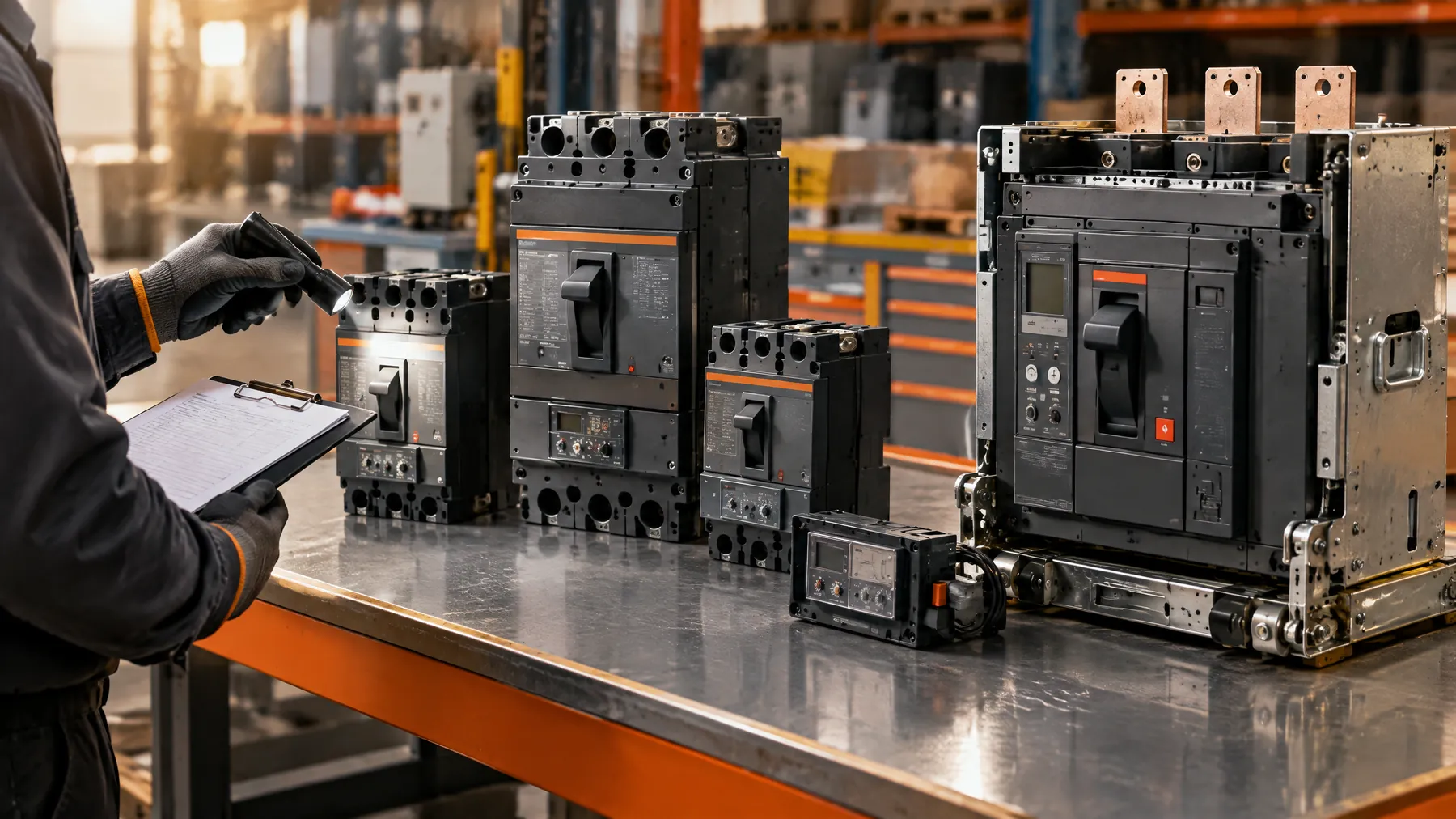
The information that gets an answer faster
A photograph of the breaker face is rarely enough. Include the manufacturer, exact catalog or model number, product family, frame size, sensor or trip rating, voltage, number of poles, interrupting rating, mounting style, operating method, included trip unit, accessories, quantity, and condition. Photograph the front, sides, rear connections or stabs, trip unit, labels, and any visible damage. For draw-out breakers, include the matching cell or cradle and secondary disconnect information. For a mixed lot, use a spreadsheet and give every photograph group the same inventory identifier used in the list.
How circuit-breaker value is evaluated
There is no responsible universal price per breaker or per amp. Value depends on the exact identity, present replacement demand, condition, testing history, completeness, quantity, storage, packaging, and transaction cost. A discontinued breaker can be useful when facilities still maintain compatible equipment. A new breaker can be difficult to market when the identity is unclear, packaging is damaged, or demand is limited. Large matching quantities may create an efficient opportunity, while a single specialized power breaker can justify individual review.
Condition words must be supported by facts. “New surplus” should mean unused equipment with credible identification. “Used” should state whether the breaker was operating when removed and whether any current test documentation exists. “Reconditioned” should identify the work and source of the documentation. Unknown-condition equipment should be described as untested. A commercial buyer can work with uncertainty when it is disclosed; hidden uncertainty causes delays and revised assumptions.
Our four-step breaker purchasing process
Popular breaker buyer pages
Frequently asked questions
Does Surplus Generator Buyers buy circuit breakers?
Yes. We buy qualifying new, used, reconditioned, obsolete, molded-case, insulated-case, air, vacuum, panelboard, switchboard, and medium-voltage circuit breakers from commercial and industrial sellers nationwide.
What information is needed to sell a circuit breaker?
Send the manufacturer, complete catalog or model number, frame and trip rating, voltage, pole count, interrupting rating, condition, quantity, location, and clear photographs of the breaker and its labels.
Do you buy obsolete circuit breakers?
Yes, selected obsolete and discontinued breakers may be marketable. Value depends on exact identification, condition, completeness, quantity, current replacement demand, and the practical cost of shipping or removal.
Can you buy a large mixed breaker inventory?
Yes. Contractors, facilities, distributors, and liquidation teams can submit mixed inventories. A spreadsheet tied to labeled photograph groups is the fastest way to review a large lot accurately.