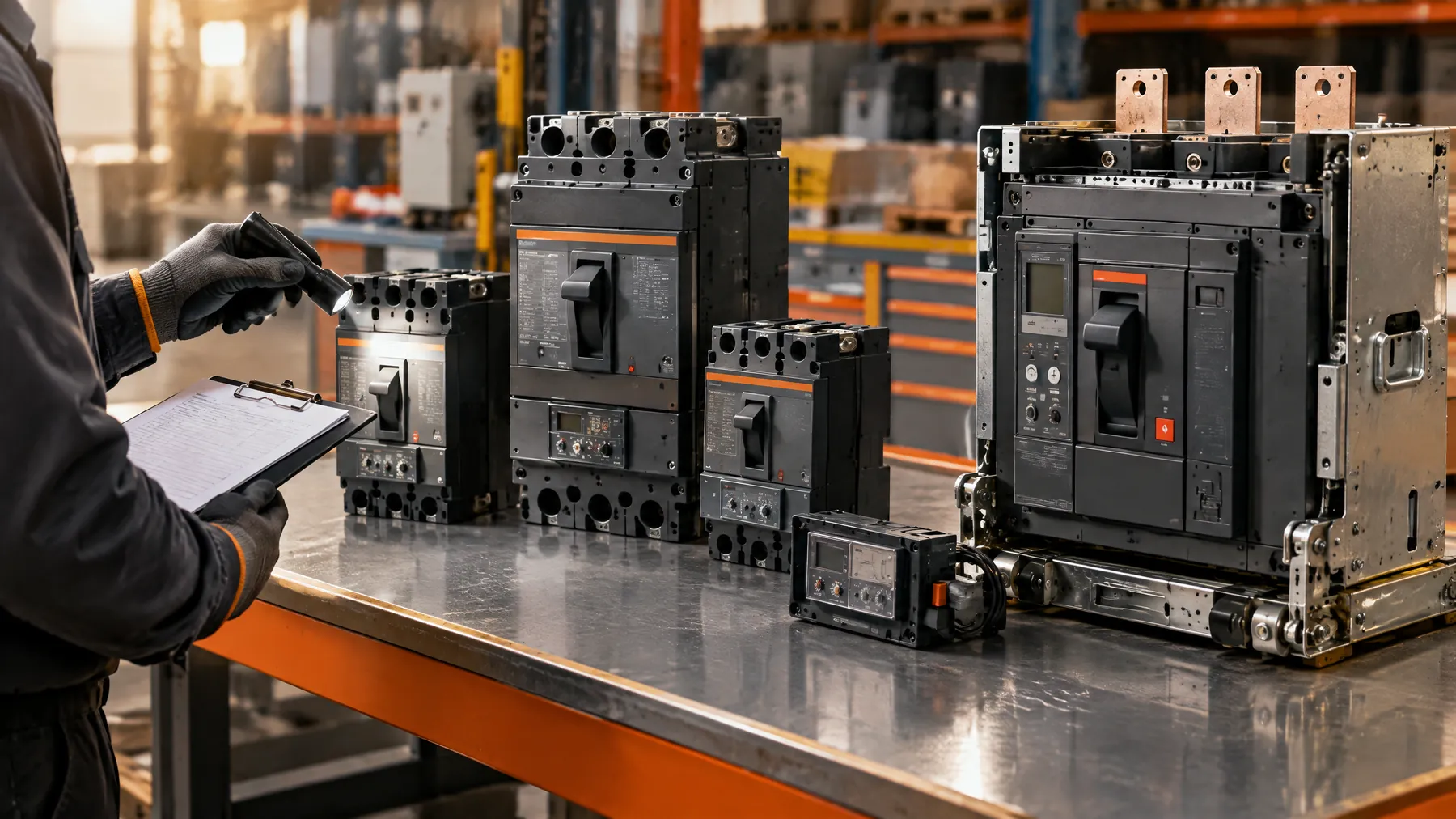
Do we buy equipment covered in Breaker Types?
Yes—we buy many commercial circuit-breaker types when the construction, mounting, ratings, condition, and demand support resale. Start by deciding whether the unit is molded-case, insulated-case, air, vacuum, draw-out, fixed-mount, panelboard, switchboard, or medium-voltage equipment.
Choose the closest matching guide
Breaker type determines the information a buyer needs. A molded-case unit is usually identified by its molded housing, frame family, trip rating, poles, voltage, and interrupting rating. A draw-out air or vacuum breaker also requires photos of the primary contacts, secondary disconnects, racking mechanism, cell or cradle relationship, controls, and nameplate. The same ampere number does not make two breakers interchangeable.
Molded-Case Circuit Breaker Buyers
Identification, qualification, value factors, and seller guidance for molded-case circuit breakers (MCCBs).
Air Circuit Breaker Buyers
Identification, qualification, value factors, and seller guidance for air circuit breakers.
Insulated-Case Circuit Breaker Buyers
Identification, qualification, value factors, and seller guidance for insulated-case circuit breakers.
Vacuum Circuit Breaker Buyers
Identification, qualification, value factors, and seller guidance for vacuum circuit breakers.
Motor Circuit Protector Buyers
Identification, qualification, value factors, and seller guidance for motor circuit protectors.
Panelboard Circuit Breaker Buyers
Identification, qualification, value factors, and seller guidance for commercial panelboard circuit breakers.
Switchboard Circuit Breaker Buyers
Identification, qualification, value factors, and seller guidance for switchboard circuit breakers.
Draw-Out Circuit Breaker Buyers
Identification, qualification, value factors, and seller guidance for draw-out circuit breakers.
Fixed-Mount Circuit Breaker Buyers
Identification, qualification, value factors, and seller guidance for fixed-mount circuit breakers.
Medium-Voltage Circuit Breaker Buyers
Identification, qualification, value factors, and seller guidance for medium-voltage circuit breakers.
Build a verifiable breaker record
Photograph the complete front, both sides, rear connection area, nameplate, trip unit, mounting hardware, and any included cradle or cell. State whether the breaker is fixed or draw-out, manually or electrically operated, and whether it was removed from operating equipment. Keep barriers, plugs, shutters, racking handles, and loose accessories identified with the correct unit.
A useful inventory does not rely on file names such as “breaker one” or “large GE.” Assign an identifier to every unit or group of identical units. Use that identifier in the spreadsheet and in every photograph name. If several breakers came from one lineup, record the lineup, section, compartment, and matching cell information. Keep mixed conditions on separate rows. This method allows the seller and buyer to discuss the same asset without reopening every image.
What determines commercial demand?
Marketability depends on a specific replacement need, not the broad fact that an object is a circuit breaker. Buyers compare manufacturer, family, ratings, mounting, connection style, trip technology, controls, accessories, condition, quantity, and geographic location. Current products may have broad demand. Older families can remain useful to facilities maintaining installed systems. Other items may be too common, incomplete, damaged, unidentified, or expensive to move relative to demand. An accurate review distinguishes those outcomes before a seller invests in packing or freight.
Commercial guidance—not electrical instructions
Do not energize, rack, test, disconnect, or remove commercial electrical equipment unless qualified personnel are authorized to perform the work. A buying guide helps identify sale information; it is not an installation, maintenance, or safety procedure.
From initial photos to a documented sale
Send the strongest identification first. We review the opportunity, ask for any missing facts, and determine whether the equipment fits the purchasing program. If it does, the transaction should define the breaker list, condition assumptions, inspection terms, payment, availability, packaging, loading, and transportation. Installed equipment must be released by the authorized site team. Stored equipment should be protected from moisture, impact, loose hardware, and mixed identification while the review is underway.
For a large inventory, start with an executive summary: total approximate quantity, major manufacturers, general condition categories, city and state, storage situation, and required timeline. Follow with the detailed spreadsheet and photograph folders. This approach lets a buyer understand the opportunity quickly while retaining the item-level evidence needed for a reliable offer.
Explore the complete breaker authority center
Frequently asked questions
Do you buy the breaker types listed here?
Yes—we buy many commercial circuit-breaker types when the construction, mounting, ratings, condition, and demand support resale. Start by deciding whether the unit is molded-case, insulated-case, air, vacuum, draw-out, fixed-mount, panelboard, switchboard, or medium-voltage equipment.
What should I send for an initial breaker review?
Send the manufacturer, exact catalog or model number, frame and trip information, voltage, poles, interrupting rating, mounting, condition, quantity, location, and current photographs of the complete breaker and every label.
Can used or obsolete breakers qualify?
Yes. Selected used and obsolete equipment may qualify when it is identifiable, complete enough for review, honestly described, and supported by current replacement demand. Age alone does not establish or eliminate marketability.
Do you coordinate shipping or pickup?
Shipping, freight, and pickup are addressed according to the size, quantity, packaging, location, and site conditions. The agreed offer should state each party’s responsibilities before equipment is released.